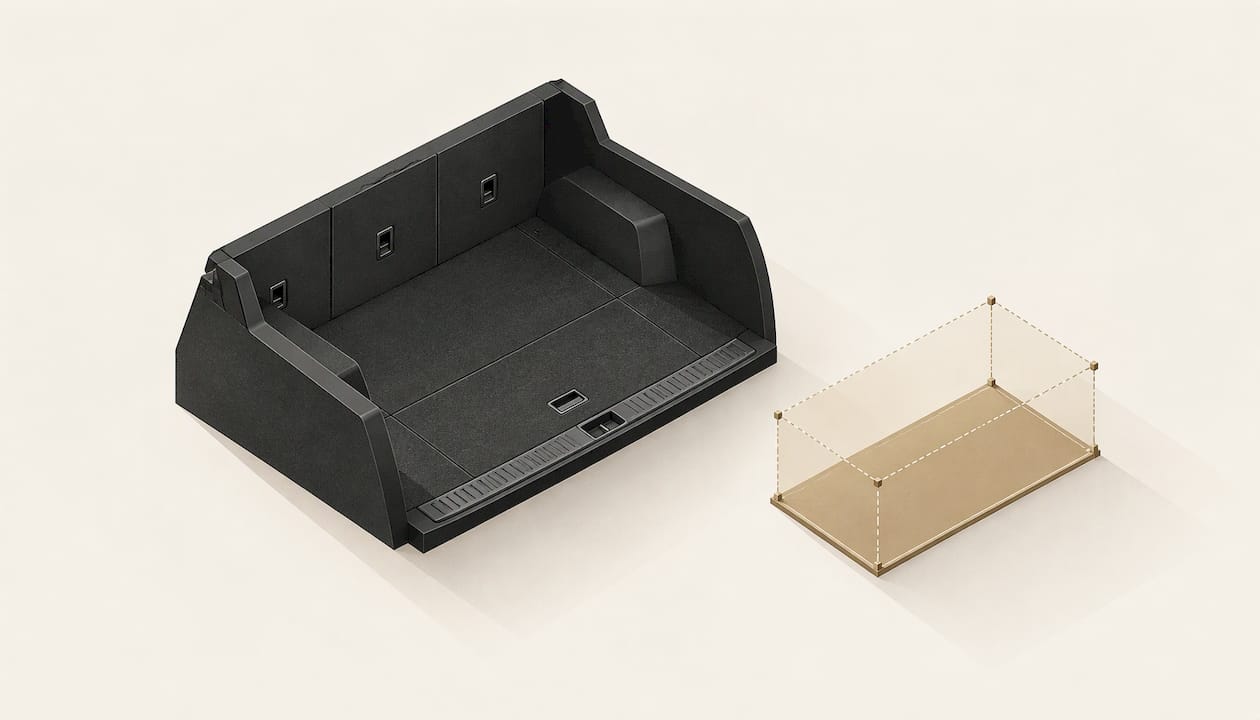
The cars with the most cargo space are three-row SUVs and minivans, but the number on a spec sheet only tells you part of the story. To pick a car that actually fits your life, compare figures measured the same way, check the shape of the load area and the way the seats fold, and then confirm it with your own gear at the dealership. Below you will find how cargo space is measured, which vehicles lead, and how to weigh legroom against luggage.
TL;DR
- Cargo space is a volume figure, in cubic feet in the US. Compare only numbers measured by the same method, because different methods give different results for the same car.
- Minivans and full-size SUVs lead the volume rankings. Wagons, hatchbacks and compact SUVs often load more easily day to day.
- Shape matters as much as volume: opening size, floor height, roof height and how the seats fold decide what fits.
- With a third row in use, cargo space shrinks sharply. Look at the figure behind the last row, not just the maximum.
- Balance cargo with rear legroom and headroom, then test your own stroller, suitcases or golf bags in the car.
Table of Contents
- What car cargo space actually means
- How cargo space is measured, and why figures disagree
- Which vehicles offer the most cargo space
- Volume is not everything: shape decides what fits
- Fold-flat seats: what to check
- Cargo space versus legroom and passenger room
- Match the car to your life
- A test-visit checklist
- Find a roomy car on Luxe Auto Marketplace
- Quick answers by need
- FAQ
- Sources
What car cargo space actually means
Cargo space is the volume of the area you can fill with luggage, groceries or gear. In a sedan that is the trunk. In an SUV, wagon, hatchback or minivan it is the area behind the rear seats, and it grows when you fold those seats down.
Spec sheets usually list two numbers for vehicles with folding seats:
- Behind the rear seats (seats up): what you have when carrying passengers.
- Maximum cargo (seats folded): the figure with the rear seats flat, often measured up to the front seatbacks or the roof line.
Three-row vehicles add a third figure: the space behind the third row. That is the number a family should care about most, because it is the space left when every seat is in use.
How cargo space is measured, and why figures disagree
Two cars can look equal on paper and load very differently, partly because there is more than one way to measure.
The European VDA method fills the load area with rigid one-litre blocks measuring 200 × 100 × 50 mm, and the number of blocks that fit without deformation gives the volume in litres. It was later incorporated into ISO 3832.
The American approach follows SAE J1100, a standard first published in September 1973. It estimates closed-compartment volume by stacking simulated pieces of luggage, and open-compartment volume by multiplying representative length, width and height.
The practical difference is explained by Ford's guide to cargo volume: SAE uses smaller objects that fill more gaps, so SAE figures are normally larger and should not be compared with VDA figures. Always check that two numbers come from the same method before you decide one car is roomier.

How independent testers do it
Some publications skip the standards and measure what you would actually load. Consumer Reports' method finds the largest expandable rectangular frame that fits through the rear opening of an SUV, minivan or wagon while the hatch still closes, and reports the enclosed volume of that box. It also measures luggage capacity behind a raised third row by counting suitcases and duffel bags.
This is closer to the question every buyer faces: what is the biggest rigid thing I can put in this car and still shut the door? A figure measured this way will often be lower than the manufacturer's number, and it is the more honest one for comparing.
Which vehicles offer the most cargo space
If raw volume is the goal, you are looking at full-size SUVs and minivans. Consumer Reports' May 2026 ranking of usable cargo space, as summarized by Quartz, put these at the top:
| Vehicle | Measured cargo space |
|---|---|
| Kia Carnival Hybrid (second-row seats removed) | 72 cubic feet |
| Honda Odyssey | 71 cubic feet |
| Chevrolet Suburban | 70 cubic feet |
| Chrysler Pacifica | 66 cubic feet |
These are measured figures, which is why they look smaller than the manufacturer maximums you will see elsewhere. Brand claims for the biggest SUVs run well above 100 cubic feet, because they count every inch up to the roof with seats folded. Both kinds of number are useful, as long as you do not mix them in one comparison.
Minivans: the volume winners
A minivan's boxy shape, low floor and sliding doors make its space easy to use. Several models let the rear seats disappear into the floor, which leaves a flat load bed without any lifting. For families hauling strollers, sports equipment and groceries, this is the most practical layout there is.

Full-size SUVs: space plus a third row
Long-wheelbase versions of body-on-frame SUVs, such as the Chevrolet Suburban, are built for people who need seven or eight seats and luggage at the same time. The extended bodies exist precisely to put room behind the third row. If you regularly carry six or seven people, look at the long versions rather than the standard-length ones.
Wagons, hatchbacks and compact SUVs
Smaller vehicles do not win on total volume, but they often win in daily use. Wagons, hatchbacks and SUVs typically give the most useful space because they offer a wide opening and easy loading, though opening size, floor shape and seat layout matter more than body style alone.
Sedans and large trunks
Sedans are the choice for buyers who want a large trunk without an SUV's size or running costs. A sedan trunk is enclosed and secure, and it keeps cargo out of sight. The trade-off is the opening: a trunk lid is a smaller target than a hatch, so a bulky box that fits by volume may not go through. Check the opening width and the lid hinges, which can intrude into the space on some models.
Volume is not everything: shape decides what fits
The clearest example comes from a Car and Driver comparison of the Subaru Outback and Forester. With seats folded the two had almost identical paper volumes, 76 versus 75 cubic feet. Yet the taller Forester held 28 carry-on bags to the Outback's 24, because roof height and shape determine how things stack.
Here is what to look for when you stand at the back of a car:
- Opening width and height. A big interior behind a small opening is hard to use.
- Liftover height. A low load floor is easier on your back when you lift a stroller or a heavy bag in and out.
- Floor shape. Wheel wells that intrude, a sloping roofline or a shallow well all cut into usable space.
- Roof height. Tall, upright cargo areas stack boxes better than low, swooping ones.
- Under-floor storage. A hidden compartment keeps small items out of the way and frees the main floor.
A low coupe or a sloping fastback may list a respectable number and still not take a tall box. Boxier shapes use their volume better.
Fold-flat seats: what to check
Folding seats multiply a car's usefulness, but only if they fold the right way. When you test a car, look at these points:
- Flat or stepped? A truly flat floor lets long items slide in. A slope or a step wastes space and lets things slide around.
- Split ratio. A 60/40 split lets you carry a long item and a passenger or two at the same time. In its test of the Tesla Model 3, Car and Driver found that the 60/40 rear seatbacks fold flat for an uninterrupted cargo floor, and that there is a large under-floor storage compartment.
- Release levers. Levers in the cargo area or on the seat shoulders save you from walking around the car to fold seats.
- Third-row folding. In a three-row vehicle, check whether the third row folds into the floor or has to be removed, and whether it folds flat.
- Gap at the front seats. If the folded seat leaves a gap or a ridge, small items can fall through.
Try this: fold the seats, then lay your longest item across the floor. Skis, a flat-pack bookshelf or a folded stroller will tell you more than a number will.
Cargo space versus legroom and passenger room
Most buyers do not want to give up passenger comfort for luggage. Many of the cars that come up when people search for the most legroom are also the cars with large cargo areas, but the two do not always move together.
A useful rule from MotiveGrid's guide to car space: focus on rear legroom, headroom and cargo capacity behind the seats, rather than the single total passenger volume figure that often leads a spec sheet. Total passenger volume lumps front and rear together and rewards tall, boxy cabins.
So compare these three things side by side:
| What to compare | Why it matters |
|---|---|
| Rear legroom | Decides whether adults, or a rear-facing child seat behind a tall driver, fit comfortably |
| Headroom | Matters for tall passengers and for bulky child seats |
| Cargo behind the last row in use | The space you really have when the car is full |
Three-row vehicles are where the two collide. A third row eats cargo space, so a car that lists 100 cubic feet maximum may offer only a modest amount behind the third seat. If you will seat the third row often, the behind-the-third-row number is the one that counts.
Match the car to your life
Families with young children
Strollers, car seats, diaper bags and groceries add up fast. Prioritize a low liftover, a wide opening, sliding or wide-opening doors, and flat-folding seats. Minivans and three-row SUVs lead here, and a compact SUV with a tall cargo area can be enough for a family of three or four.
Luxury buyers
Luxury cars span a wide range. A large luxury SUV may pair a plush second row with generous space behind the third row, while a sports coupe or sedan has a more modest trunk. Decide whether you need weekend luggage for two or four, and compare measured figures, not just brochure claims. A power liftgate and a hands-free opener are worth looking for if you will load often.
First-time buyers
Start from what you carry in a typical week, not once a year. A hatchback or compact SUV covers most first cars and parks easily. If you occasionally need more room, folding seats usually cover it better than buying a bigger vehicle you drive every day.
Buyers comparing dealerships
If you are narrowing down a few candidates, line up the same model at different sellers and compare trim, options and condition. Cargo features such as a power liftgate, a cargo cover, a rear-seat release or a third row can vary by trim, so confirm what the specific vehicle has.
A test-visit checklist
When you see a car in person, bring your gear. Here is a quick routine:
- Bring your largest regular item: a stroller, a golf bag, a suitcase, a cooler.
- Load it with the seats up, then repeat with the seats folded.
- Close the hatch or trunk with everything inside.
- Check that you can still see out of the rear window.
- Sit behind the driver's seat set for your height and check legroom.
- Install your child seat if you have one and see how much room is left for the front passenger.
- Fold and raise the third row if there is one, and note how much cargo space remains.
Find a roomy car on Luxe Auto Marketplace
Once you know which body style suits you, the next step is a shortlist. Luxe Auto Marketplace lets you search vehicles by make, body style and price range, and browse curated collections for everyday and luxury vehicles, including SUVs, sedans, coupes, trucks, electric cars and sports cars. Our dealership-first approach connects you directly with trusted sellers, and you can compare options side by side before you reach out.

For a family car, start with the SUV and everyday collections. For a premium vehicle with room to spare, the luxury collection is the place to begin.
Quick answers by need
- Most space, period: minivans and full-size SUVs.
- Easy daily loading: hatchbacks, wagons and compact SUVs with a wide opening.
- Secure, out-of-sight storage: a sedan with a large trunk.
- Long items: any car with a flat, 60/40 split folding seat.
- Seven passengers plus luggage: a long-wheelbase three-row SUV or a minivan.
- Tall boxes: choose a taller, boxier cargo area over a sleek roofline.
FAQ
How many cubic feet of cargo space is a lot?
It depends on the type of vehicle. In Consumer Reports' May 2026 measured ranking, the leaders sit between 66 and 72 cubic feet, and those are minivans and big SUVs. A mid-size sedan trunk is far smaller, and for many buyers a compact SUV is plenty. Judge the number against the vehicle class and your real loads.
Why does the same car show different cargo numbers on different sites?
Because manufacturers and publications use different methods. VDA fills the space with one-litre blocks, while SAE uses smaller objects that fill more gaps, so SAE figures are normally larger. Some testers measure the largest box that fits through the opening. Compare numbers from a single source and method.
Do fold-flat seats really add usable space?
Yes, when the floor is truly flat and the seats split in a useful ratio such as 60/40. They let you carry long items while keeping a seat or two for passengers. Test the fold in person, because a step or slope in the floor can waste part of the gain.
Which is better for cargo, an SUV or a sedan?
An SUV usually wins on versatility because of its taller space, wider opening and folding seats. A sedan can still have a large trunk, and it keeps your luggage out of sight. Check the trunk opening, since a big volume behind a narrow opening can be hard to load.
How much cargo space is left with the third row up?
Less than most people expect. Space behind the third row is listed separately from the maximum figure, and it can be small even in vehicles with a very large maximum. Check that specific number, or load your luggage with the third row raised.
Sources
- Measuring Vehicle Luggage Space (Metrology and Quality News)
- Interpretation of SAE J1100 Cargo Volume Indices (SAE)
- How is Cargo Volume Measured? (Ford)
- Cargo Room Actual Measured Space for SUVs, Minivans (Consumer Reports)
- 10 SUVs and minivans with the most trunk space (Quartz)
- How to Compare Car Trunk Space and Cargo Room (Engine Auditor)
- Subaru Outback vs. Subaru Forester (Car and Driver)
- 2018 Tesla Model 3 Cargo Space and Storage Review (Car and Driver)
- Car Space & Practicality Explained (MotiveGrid)